Yuzu Pocket

Yuzu Pocket - A PCB Business card that runs Linux!
compact and delightfully unnecessary.
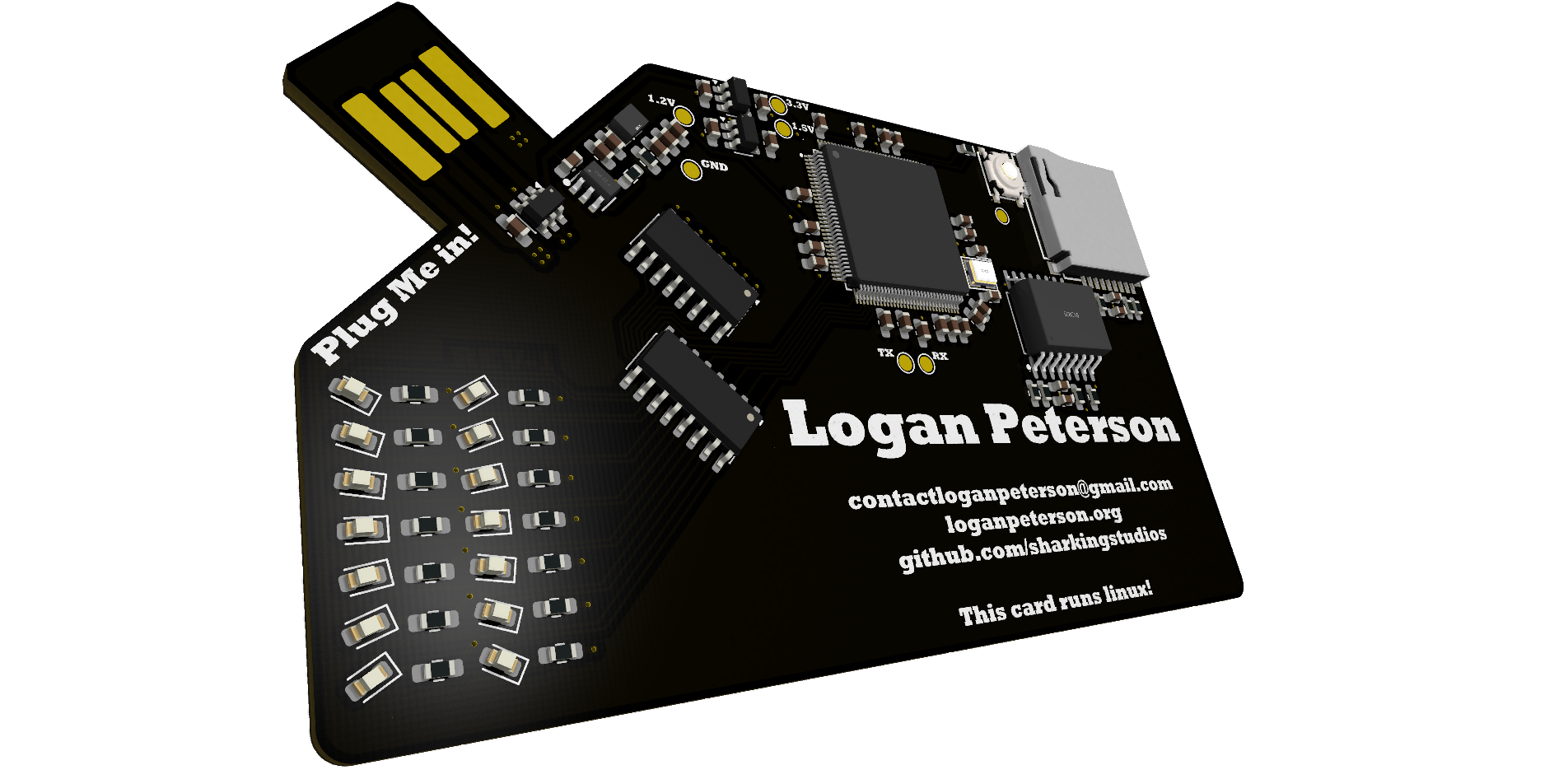
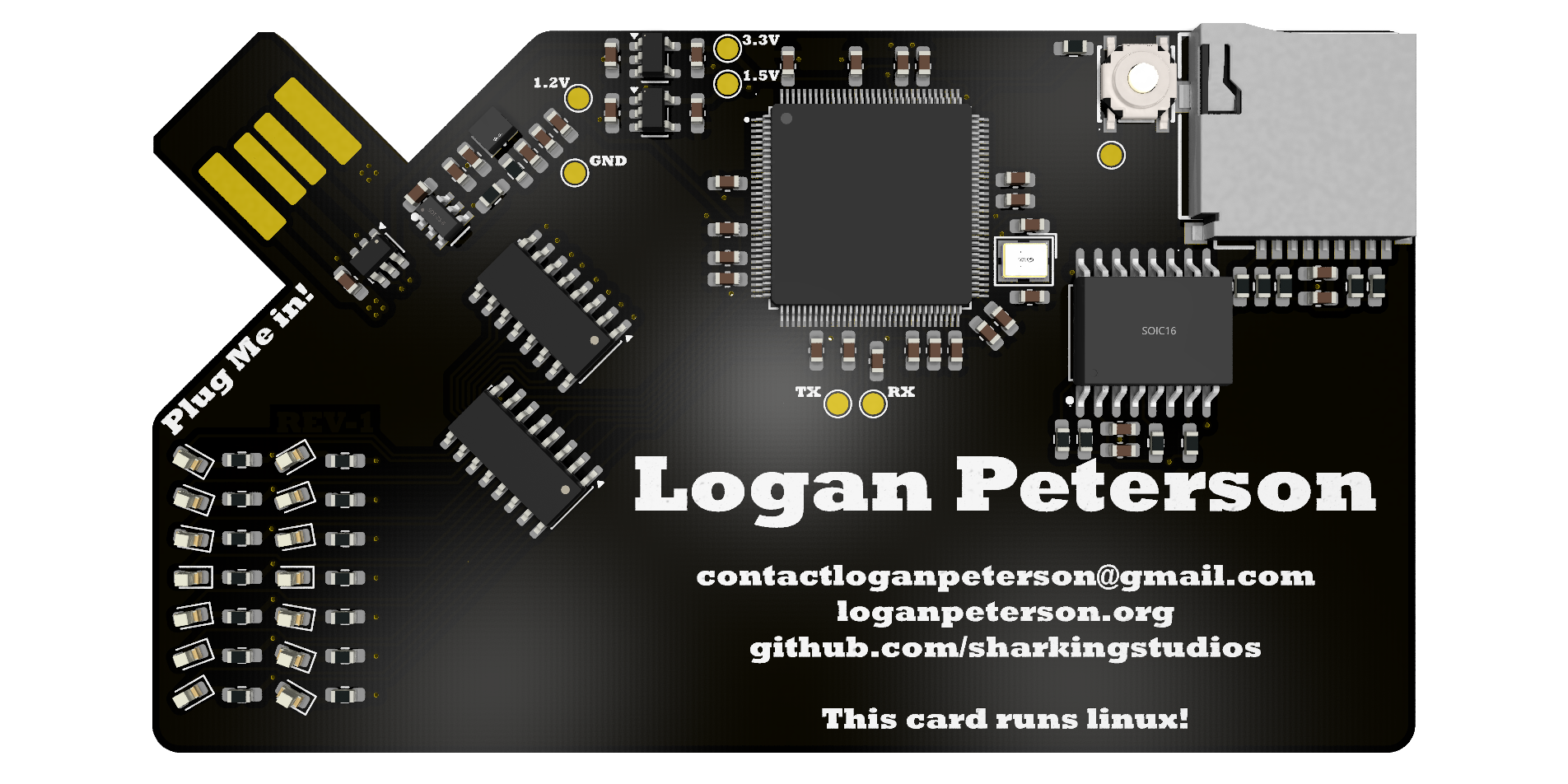
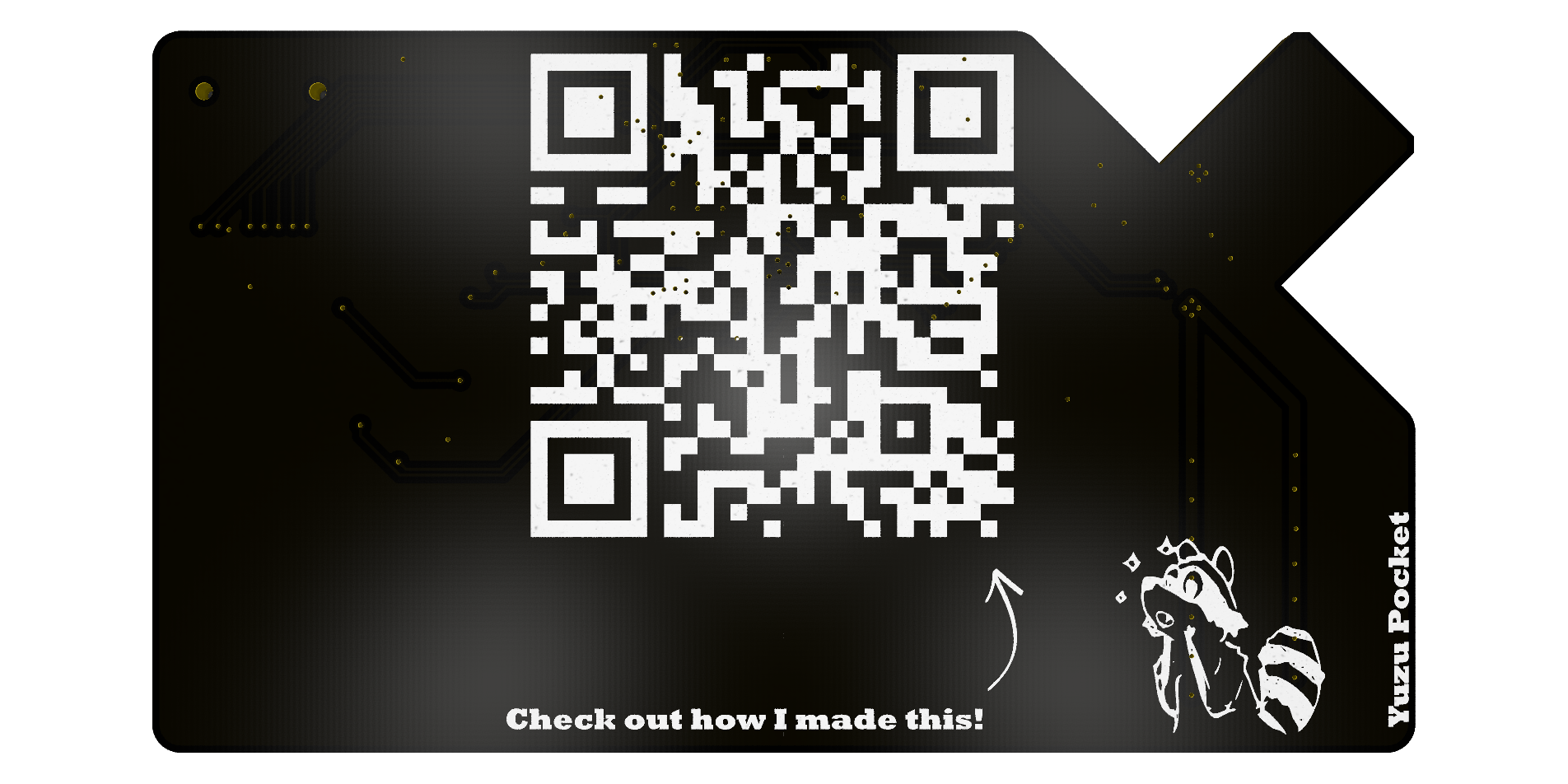
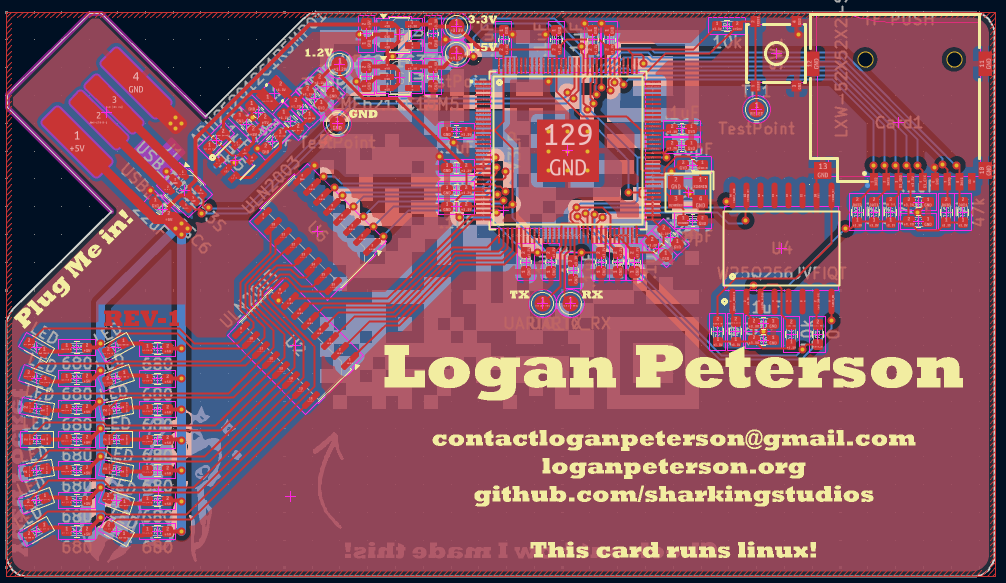
Renders
Visuals because everyone loves eye candy.
Project Files
The full open-source project lives here.
BOM
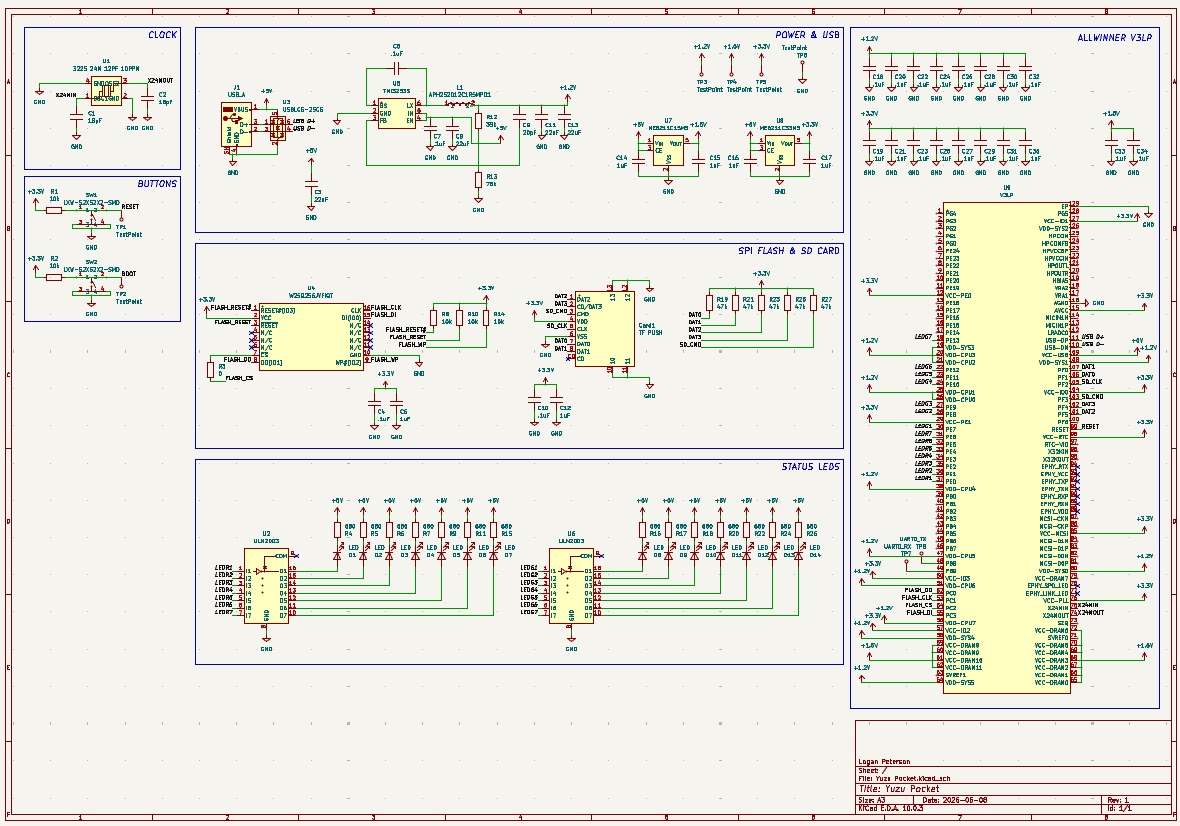
All the processors and storage sit here.
Main characters:
- Processor: Allwinner V3LP
- Onboard Storage: Winbond W25Q256JVFIQT 256Mbit SPI flash
- More Storage: Micro SD Card Slot
- Blinken Lights: Red and Green
- Misc: Boot circuitry, reset logic, pull-ups, decoupling, and other necessary magic
(See BOM.md for full part values, footprints, and sourcing.)
What is this?
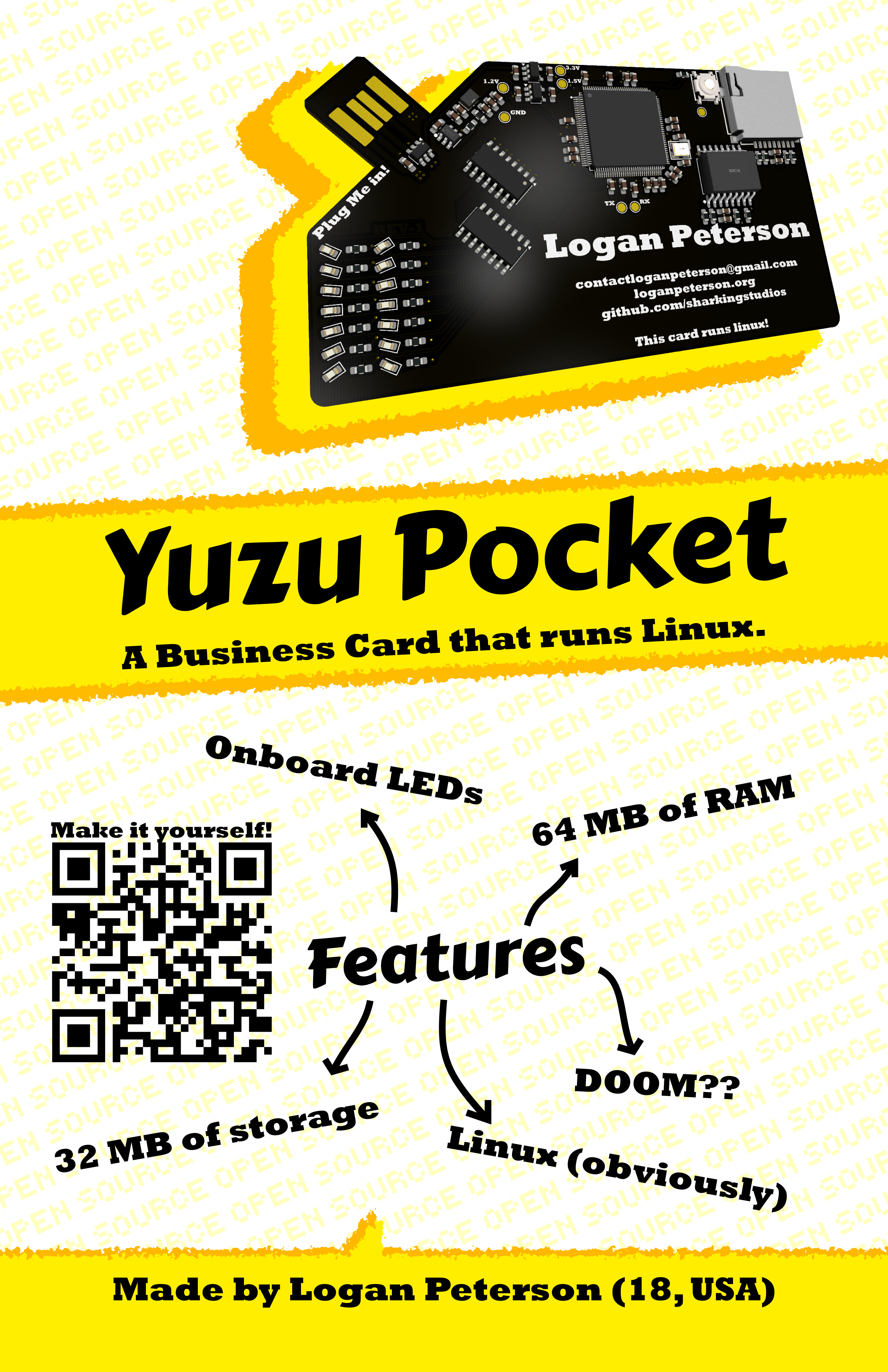
The Yuzu Pocket is a Business Card that runs Linux built around an Allwinner V3LP processor, designed to give important individuals my portfolio with some pizzazz!
It does this using its onboard USB port, integrated right into the PCB copper, to talk to the host computer. To keep things interesting, the board exposes itself as a USB gadget, giving the host multiple points of access into the board.
How It Works
On startup, the board will connect to the host computer and expose itself as a network device, as well as a mass storage device.
The mass storage that opens acts as the quick menu, and links the user to the more interesting parts of the project, including the hosted webpage at loganpeterson.local that exposes a shell, giving the user direct access into the device (where they can play the integrated terminal games / demos)
At a high level:
- The card is plugged into a USB port
- The V3LP boots U-Boot and Linux
- Linux creates a composite USB gadget containing:
- A small read-only help drive
- A USB network interface
- A serial interface
- The host receives an address on the private USB network
- The card advertises itself as
loganpeterson.local - Opening the included shortcut launches a browser-based terminal
- The visitor is now using a Linux computer that’s the size of a business card
No extra special applications are required other than just having a host computer.
Features
A Real Linux Computer
Yuzu Pocket is not a microcontroller pretending to be a computer. The Allwinner V3LP contains a 32-bit ARM Cortex-A7 processor and 64 MB of integrated DDR2 RAM, giving the board enough room for:
- U-Boot
- A Linux kernel
- BusyBox userspace
- USB gadget services
- A web terminal
- Small native programs, games, and network demos
The firmware is intentionally based on Buildroot rather than a full desktop distribution.
Plug-In USB Experience
The copper fingers on the edge of the PCB form a USB-A connector. Plugging the card into a computer is intended to provide both power and communication.
The Linux USB gadget configuration can expose several functions over that single connection:
- Mass storage
- Shows
HOW_TO_USE.txt - Includes browser shortcut files
- Acts as the card’s quick-start menu
- Shows
- USB Ethernet
- Creates a private network between the host and Yuzu Pocket
- Uses
10.0.0.1as a fallback address
- USB serial
- Provides another route into the Linux console
- Web terminal
- Served by
ttyd - Intended URL:
http://loganpeterson.local:7681/
- Served by
Onboard Storage
Yuzu Pocket has two storage paths:
| Storage | Capacity | Purpose |
|---|---|---|
| Winbond W25Q256 SPI NOR | 256 Mbit / 32 MB | Compact onboard firmware and persistent assets |
| microSD | Card dependent | Development, recovery, larger Linux images, and experiments |
The initial development image targets microSD because it is easier to rebuild and recover. The final compact image is intended to fit within the 32 MB onboard SPI NOR, using a small kernel and compressed root filesystem.
That storage budget is tight enough to be interesting, but large enough for a fun Linux userspace.
Fourteen Blinken Lights
The card includes:
- 7 red LEDs
- 7 green LEDs
- 14 total individually controlled channels
The LEDs are driven through two ULN2003 Darlington transistor arrays. Linux sees them as GPIO-controlled indicators, allowing them to be used for:
- Boot progress
- Storage activity
- USB connection status
- Network activity
- Error codes
- Loading animations
- Gratuitous blinking
Because silent business cards are suspicious.
Firmware
Firmware lives in Firmware/ and is organized as a Buildroot external tree.
The closest upstream starting point is the Allwinner V3s / Lichee Pi Zero support found in U-Boot and Linux. V3LP is treated as V3s-like for the initial port, with DRAM initialization being the part most likely to require V3LP-specific work.
See the firmware README for build commands, image layout, and current implementation details.
What Can It Run?
The target is small native Linux software.
This includes:
- Terminal games
- LED animations
- Tiny HTTP services
- Network experiments
- My Portfolio
- A minimal Minecraft-protocol-compatible server
- Whatever fits inside the remaining storage budget
There is an integration point reserved for
p2r3/bareiron, a compact C Minecraft server experiment. It is not enabled by default yet because upstream requires generated Minecraft registry data before compilation (and I haven’t gotten to that).
Why?
The Yuzu Pocket exists because I wanted a portfolio piece that people would actually remember, rather than another ordinary business card or QR code printed on cardstock (though it has one too!).
It combines my interest in PCB design, embedded systems, and questionable software experiments into something small enough to carry everywhere and hand out to people.
Contributing
Ideas, fixes, experiments, and constructive criticism are welcome.
- Open an issue
- Submit a pull request
- Suggest a tiny program that belongs on the card
- Improve the V3LP boot support
- Help reduce the image size
- Find a fun use for fourteen LEDs
- Make the DOOM situation worse
Please keep PCB and firmware changes clearly separated. Hardware files live in PCB/; firmware and build integration belong in Firmware/.
Disclaimer
This is an open hardware and firmware project under active development.
It includes:
- Custom power regulation
- Fine-pitch PCB assembly
- USB hardware
- Boot firmware
- Flashing tools capable of overwriting storage
- Enough exposed engineering decisions to create exciting new failure modes
If you overwrite the wrong drive, short a power rail, install a component backward, or release the magic smoke, the business card will be significantly less useful at networking events.
Continue Reading

Published on: June 19, 2026
3 min read
An RP2040 flight-assist controller for RC planes, drones, data logging, and not crashing.

Published on: December 20, 2025
3 min read
A No-Nonsense Ethernet + PoE Smart-Home Controller.

Published on: November 25, 2025
4 min read
A Swiss-Army-Knife control board for DIY RC chaos.